The enduring appeal of Wheel of Fortune lies not merely in its familiar spinning wheel or the satisfying click of letters appearing on the puzzle board, but in the subtle psychological drama that unfolds in real time as ordinary contestants navigate extraordinary pressure. Episodes often follow a comforting rhythm—solve, spin, guess, repeat—but every so often, a single contestant transforms a routine game into something genuinely unforgettable. These moments capture the very essence of why audiences continue to tune in decade after decade, finding renewed excitement in a format that, on the surface, seems remarkably simple.
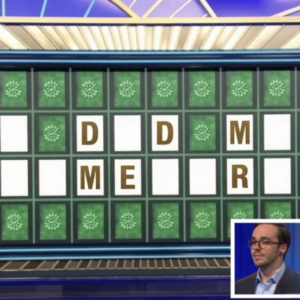
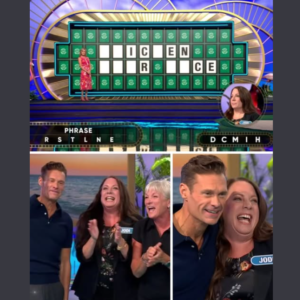
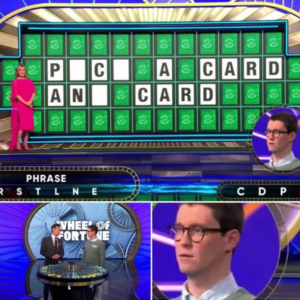
One such moment came when a contestant faced a tricky Bonus Round puzzle whose solution turned out to be “MY FANCY CLOTHES.” What initially looked like an ordinary phrase quickly became the center of attention, as the puzzle proved far more difficult than many viewers expected. As the letters slowly appeared on the board, the contestant had only a few seconds to piece together the answer while the pressure of the countdown mounted.
This is exactly what makes Wheel of Fortune so compelling. The game is never just about vocabulary or luck. It is about timing, intuition, and composure under scrutiny. Contestants must process information quickly while managing nerves, reading the puzzle board, and trusting their instincts—all while millions of viewers watch from home.
Part of the show’s enduring magic comes from its relatability. Unlike competitions featuring professionals or experts, Wheel of Fortune places ordinary people under extraordinary pressure. Teachers, nurses, parents, retirees, and students all step up to the wheel carrying dreams of winning big, but also the fear of freezing at the worst possible moment.
Every spin carries risk. Every letter selection is a strategic decision. Every puzzle becomes a delicate balance between confidence and uncertainty.
For viewers at home, the experience feels interactive. Audiences shout answers at their televisions, celebrate correct guesses, and groan when contestants miss phrases that seem obvious from the couch. Yet once the camera focuses on a contestant standing beneath the bright studio lights, it becomes clear that solving a puzzle on national television is entirely different from solving one in your living room.
The pressure is immense.
The clock ticks louder.
The lights seem brighter.
And sometimes, a phrase as simple as “MY FANCY CLOTHES” can suddenly feel impossible to see.
That combination of simplicity and pressure is what creates the show’s most memorable moments. Some contestants stage remarkable comebacks, while others suffer heartbreaking near misses. Occasionally, a single puzzle sparks debate among viewers and becomes one of the most talked-about moments of the season.
Even after decades on the air, Wheel of Fortune continues to captivate audiences because it understands something timeless about human nature: people love watching ordinary individuals rise to extraordinary moments.
At its heart, the show is more than a word game. It is a test of confidence, quick thinking, and resilience under pressure.
And sometimes, all of that drama comes down to three simple words:
“MY FANCY CLOTHES.”