These sisters were born sharing a single skull. Doctors warned that separating them could be fatal.
Manal and Mirhi were born in Pakistan with an extremely rare condition known as craniopagus twins—joined at the head. They shared part of their cranial bone and a complex network of blood vessels, making their case one of the most challenging doctors had seen. Births like theirs occur in roughly one out of every 60,000 deliveries, and only a small number of children survive long enough for surgery to even be considered.
For three years, the girls lived side by side, inseparable in every sense. When they reached the age of three, their parents faced an impossible decision: attempt a high-risk separation or continue life with mounting medical dangers. Together with specialists, they chose to move forward.
The twins were transferred to Bilkent City Hospital in Ankara, where an international team of experienced surgeons took over the case. Months of preparation followed. Using advanced mixed-reality technology, doctors created detailed 3D models of the girls’ skulls and brains, allowing them to rehearse every step of the operation before entering the operating room.
The separation was performed in stages, with the final surgery lasting more than 14 hours. Surgeons carefully divided the shared membranes and blood vessels before reconstructing each child’s skull. The risk was enormous—but the outcome was extraordinary.
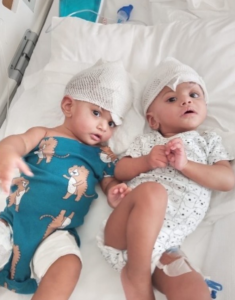 The operation was a success.
Within days, Manal and Mirhi began breathing on their own and responding to their environment. Doctors report that their recovery has exceeded expectations, and they are now undergoing rehabilitation, learning to sit, move, and explore the world as two separate individuals.
For their parents, the result feels nothing short of a miracle. For the first time, they can hold each daughter in their arms—separately.