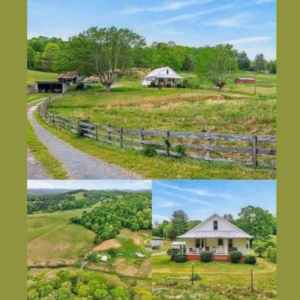
At first glance, the numbers feel like a mistake. Ninety-five acres of land. A full-sized home with three bedrooms and two bathrooms. Nearly 2,700 square feet of interior living space. All listed for just $135,000. In a housing market where modest city apartments now rival the price of suburban homes from a decade ago, this listing stopped people in their tracks. It spread quickly online, shared with disbelief and curiosity, sparking the same question again and again: how is this possible?
In an era defined by bidding wars, waived inspections, and buyers stretching themselves thin just to secure a roof over their heads, the idea that nearly one hundred acres of land could be purchased for less than the cost of a starter condo feels almost fictional. But this property is real, and its existence highlights a side of American real estate that has quietly remained out of the spotlight—one shaped not by scarcity, but by geography, lifestyle trade-offs, and shifting definitions of value.
The property sits outside Hannibal, Missouri, a small historic city best known as the boyhood home of Mark Twain and its location along the Mississippi River. Unlike booming metropolitan regions, Hannibal has never experienced runaway housing demand. It is a place where life moves slowly, where generations often stay rooted, and where land is measured not by proximity to nightlife or corporate offices, but by how much sky you can see from your front porch.
A long gravel driveway leads deep into the property, winding through open land before revealing the house itself. There is no dense neighborhood here, no traffic noise, no streetlights washing out the night sky. The home appears solid and lived-in, not staged for social media perfection or polished to chase fast offers. It feels honest. Functional. Real. The kind of house built to be lived in rather than flipped.
What truly sets this listing apart, however, is the land. Nearly ninety-five acres stretch outward in all directions, combining open pasture, rolling fields, and wooded areas that provide both privacy and natural beauty. A small pond sits quietly within the acreage, adding not just scenic value, but practical potential for livestock, irrigation, or recreation. Several outbuildings are scattered across the land, offering space for storage, workshops, farming equipment, or future expansion.
In today’s market, land is often the most expensive and most limited resource. Many buyers have become accustomed to trading square footage for location, accepting smaller homes and shared walls in exchange for convenience. This property flips that equation entirely. Here, space is abundant. Neighbors are distant. Silence is the default. The land itself becomes a form of wealth—one that cannot be replicated once it is gone.
Inside the home, the scale continues to surprise. With nearly 2,700 square feet, the layout offers room to breathe. Large living areas allow for family gatherings, quiet evenings, or flexible use as home offices or creative spaces. Bedrooms are generously sized. Natural light filters through the windows, connecting the interior to the surrounding landscape. This is not a bare shell or a primitive structure. It is a livable house with strong bones, ready to be occupied while improvements are made over time.
Of course, a price this low does not exist without reasons. Location is the most significant factor. While Hannibal provides essential services, schools, healthcare, and basic shopping, it does not offer the economic density of larger cities. Job opportunities are more limited. Commuting to major employment centers is not practical for most professions. Internet access, while available, may not match urban speeds in all areas. Winters can be isolating. Emergency services take longer to reach rural properties.
For many buyers, these realities are deal-breakers. Modern life has been built around convenience—quick access, instant delivery, and constant connectivity. This property is not designed for that lifestyle. It demands a different rhythm, one based on planning rather than spontaneity, self-sufficiency rather than outsourcing, and patience rather than immediacy.
But for others, those same factors are exactly what make the property appealing.
This listing speaks to a growing group of people who feel increasingly disconnected from modern housing trends. People exhausted by rising rents, shrinking apartments, and the feeling that they are working endlessly just to remain stationary. People who value ownership not as a status symbol, but as security. People who see land not as a luxury, but as freedom.
With nearly one hundred acres, the possibilities extend far beyond residential living. Farming, livestock, hunting, conservation, or off-grid experimentation all become realistic options. The land can generate food, income, or simply peace of mind. In uncertain economic times, land ownership carries a psychological weight that cannot be measured purely in dollars.
There is also a deeper cultural shift reflected in listings like this. For decades, success was defined by proximity—closer to cities, closer to jobs, closer to opportunity. Now, for the first time in generations, technology has allowed some people to decouple income from location. Remote work, online businesses, and digital services have made rural living viable for those willing to adapt.
This property is not for everyone. It requires intention, resilience, and a willingness to live differently. It asks buyers to trade convenience for autonomy, speed for space, and noise for quiet. It rewards those trades generously, but it does not soften the reality of rural life.
Still, the fact that such a property exists at this price reveals something important: the American real estate market is not a single story. While some regions face extreme scarcity and inflated values, others remain overlooked—not because they lack worth, but because they offer a different kind of value.
Whether this property sells immediately or waits patiently for the right buyer, it serves as a reminder that opportunity has not vanished. It has simply shifted. Affordable land still exists in the United States. It exists beyond city limits, beyond trend cycles, and beyond the assumptions many people make about what is possible.
For the right person, this is not just a house outside Hannibal, Missouri. It is space to breathe. It is ownership without crushing debt. It is the rare chance to step off the treadmill of constant consumption and into a life defined by land, quiet, and choice.
And for those who never thought such a listing could still exist, it quietly challenges one of the most powerful narratives of modern housing: that there is no alternative.