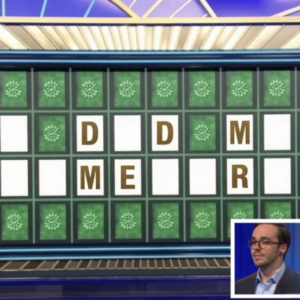
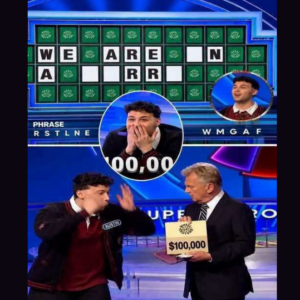
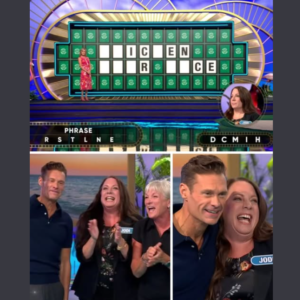
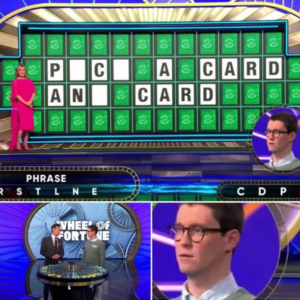
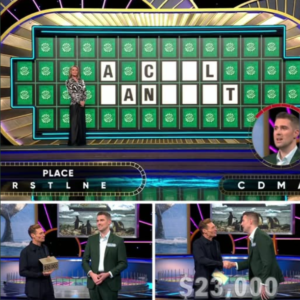
Wheel of Fortune fans expressed strong frustration after two contestants appeared unfamiliar with the basic mechanics of the Final Spin round, requiring host Ryan Seacrest to step in with corrections. The incident occurred during the February 9 episode, which launched NASCAR Week—a special tournament format where the three highest scorers return on Friday for a chance to win a trip to the Daytona 500. Cyndi Carrick from Trophy Club, Texas, emerged as the night’s champion, but the spotlight quickly shifted to moments of confusion in the endgame that left audiences bewildered.
Carrick, a devoted wife and mother who enjoys attending rock concerts, faced off against D.J. Csaszar, a car enthusiast from Phoenixville, Pennsylvania, and Quynh Van-Murry, an acapella barbershop singer from Chino Hills, California. From the outset, Carrick displayed sharp instincts by solving both early toss-up puzzles, banking $3,000. She built a commanding lead by cracking the “Never Have I Ever” category with “Gotten a Speeding Ticket,” adding $6,500 to her total. The momentum continued when Van-Murry nearly completed a “Before & After” puzzle but landed on Bankrupt. Carrick capitalized immediately, solving the tricky “I Think I Can I Think I Can of Tuna” for another $7,500.
Further success came in the prize puzzle round, where Carrick unlocked a vacation to Curacao by figuring out “Bright & Breezy.” She admitted the solve was partly a guess, yet it propelled her earnings to $19,100 at that stage. The Triple Toss-Ups saw Carrick claim two of the three puzzles, while Csaszar finally got on the scoreboard with the remaining one. These exchanges kept the energy high and showcased the competitive spirit fitting for NASCAR Week, where racing-themed excitement blended with classic game show tension. Carrick’s consistent solves highlighted her quick thinking and familiarity with common puzzle patterns, positioning her as the clear frontrunner heading into the final stages.
The episode highlighted personal stories that added depth to the competition. Carrick’s love for live music and family life resonated with viewers, while Csaszar’s passion for cars and Van-Murry’s musical talents brought diverse backgrounds to the stage. As the main game wrapped up, Carrick held a solid advantage, setting the stage for what should have been a straightforward Bonus Round opportunity. However, the transition to the Final Spin revealed surprising gaps in the contestants’ understanding of long-standing rules, sparking widespread discussion afterward.
Rule Missteps in the Final Spin Leave Fans Astonished
The Final Spin round, which determines the winner’s final cash amount through a single spin plus $1,000 per correctly called letter, became the focal point of confusion. In this phase, vowels are provided at no cost—they neither add nor deduct money—but contestants must call consonants to earn payouts. When Csaszar requested to buy a vowel, Seacrest politely intervened: “Nope. Sorry. I can’t let you do that.” Moments later, Van-Murry inquired whether she needed to spin the wheel, prompting the host to clarify that she should simply name a letter instead.
Csaszar ultimately solved the puzzle “Lapping the Competition,” earning $16,800 for his efforts. While this added a respectable sum to his total, the preceding exchanges highlighted a lack of preparedness that surprised many longtime watchers. The rules for this round have remained consistent across thousands of episodes, yet the hesitation and incorrect requests created an awkward pause in the flow. Seacrest handled the situation gracefully, guiding the players without disrupting the entertainment value, but the moment underscored how even experienced viewers at home were caught off guard by the contestants’ uncertainty.
This segment of the show typically rewards strategic letter selection and quick puzzle-solving under pressure. The need to call letters immediately after the spin, rather than purchasing vowels or requesting additional spins, is a fundamental aspect designed to keep the pace brisk. For dedicated fans, these missteps felt avoidable, especially given the show’s widespread availability and repetitive exposure to the format. The incident occurred amid the high stakes of NASCAR Week, where top performers advance for an even bigger prize, amplifying the disappointment for those rooting for smooth gameplay.
Carrick’s overall dominance carried her to victory with a final total of $23,100. Van-Murry, who finished with zero winnings from the main game, received the standard $1,000 consolation prize. The outcome rewarded Carrick’s steady performance across multiple categories, including her ability to recover from opponents’ setbacks like the Bankrupt. Her trip to Curacao added a memorable highlight, tying into the episode’s theme of speed and adventure that aligned well with the NASCAR celebration.
Audience Backlash and Ongoing Debate Over Contestant Preparation
Online reactions poured in quickly, with many Wheel of Fortune enthusiasts taking to forums like Reddit to voice their irritation. Viewers questioned how multiple contestants could overlook such core elements of the Final Spin, describing it as a recurring issue that undermines the show’s polish. Comments highlighted the frequency of similar mistakes, with one observer noting it seems almost inevitable that at least one player will struggle with the mechanics each episode. Others expressed bafflement at basic errors, such as attempting to buy vowels or asking for extra spins when the rules explicitly prohibit them.
Discussions pointed out additional pet peeves, including instances where winners fail to call a letter before attempting to solve, potentially forfeiting $1,500 or more in value. Fans wondered aloud whether participants watch the program beforehand, as the rules are demonstrated repeatedly across seasons. The frustration extended to moments of celebration, with some questioning why applause occurs during rule clarifications rather than pure solves. Phrases like “genuinely confused” and stronger expressions of disbelief captured the collective sentiment that these lapses are becoming more noticeable and disruptive.
Despite the criticism, the episode retained its charm through the contestants’ personalities and the thematic NASCAR overlay. Carrick’s win earned her a spot among the potential returnees for Friday’s finale, keeping alive the dream of a Daytona 500 experience. The tournament structure adds extra motivation, turning individual episodes into chapters of a larger narrative. Supporters appreciated Seacrest’s calm guidance, which prevented the confusion from derailing the fun entirely.
This event reflects broader conversations about contestant preparation in long-running game shows. While nerves and the bright lights of television can affect performance, basic rule familiarity is often seen as essential homework. For Carrick, the night represented a well-deserved success after navigating puzzles with confidence and seizing opportunities. Her rock concert enthusiasm and family-oriented background made her a relatable champion, even as the rule debates dominated post-show chatter.
As NASCAR Week progresses, audiences will tune in to see which players advance, hoping for sharper execution in future rounds. The February 9 episode serves as a reminder of the delicate balance between entertainment, competition, and procedural knowledge that keeps Wheel of Fortune engaging after decades on air. While the rule misunderstandings drew ire, they also sparked valuable dialogue among fans who remain passionate about the show’s traditions. Ultimately, Carrick’s $23,100 victory and the personal stories shared on stage provided plenty of positive takeaways amid the technical hiccups.